
HISTORY
Rotary has been dedicated to the idea of service for more than 100 years. Find out more about:
- The history of Rotary International
- The history of The Rotary Foundation
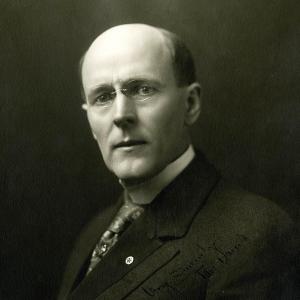
- Rotary’s founder, Paul Harris
COLLECTIONS
Rotary’s archives are open to Rotary members, Rotary staff, and the public. Learn more about resources available to researchers, scheduling an appointment and submitting requests for information and copies.
Our collections include:
- Books written by Paul Harris and other Rotarians
- Correspondence from past Rotary presidents and leaders
- Photographs of Rotarians and Rotary events
- Club banners, commemorative stamps, medals, statues, and awards
- The Rotarian magazine, from 1911 to present
- Convention Proceedings, from 1910 to present
THE FIRST FOUR ROTARIANS
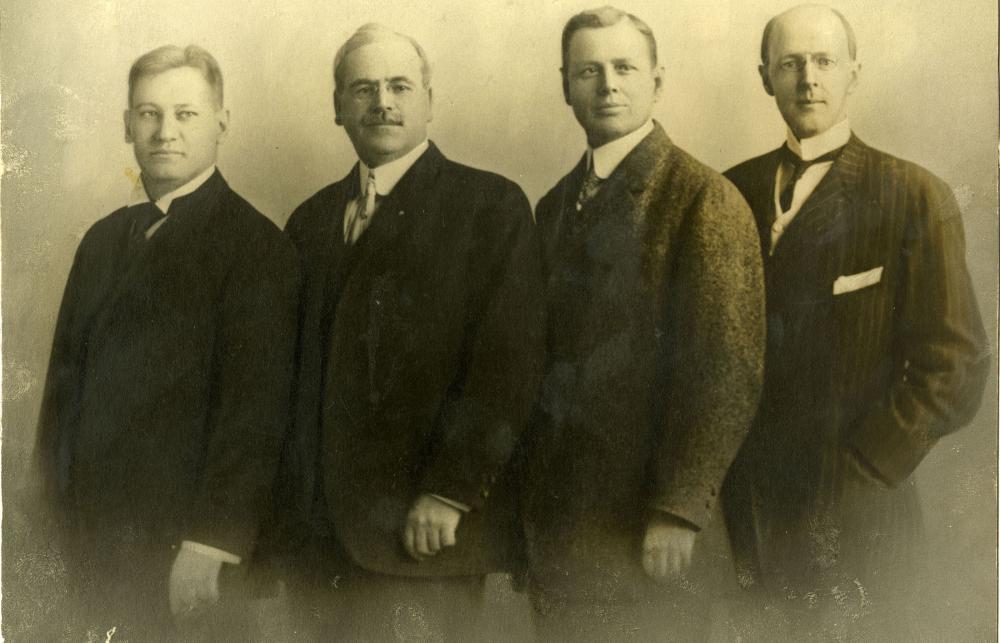
Harris’s desire for camaraderie among business associates brought together these four men and eventually led to an international organization of service and fellowship.
Read about each of the first four Rotarians below, and about Harry L. Ruggles, who is often called the “fifth Rotarian.”
Rotary’s founder, Harris, was born in Wisconsin, USA, on 19 April 1868. He was raised by his paternal grandparents in Vermont and attended the University of Vermont, Princeton, and the University of Iowa. He was Rotary president from 1910 to 1912 and a member of the Rotary Club of Chicago until his death on 27 January 1947. Learn more about the founder.
Loehr, a mining engineer, was born on 18 October 1864 in Carlinville, Illinois. He was a Rotarian for only a few years, never holding office at the club or international level. But that first Rotary meeting was held in his office, Room 711 of the Unity Building in downtown Chicago. He died in Chicago on 23 May 1918.
A Rotarian for only a few years, Shorey served as recording secretary during the club’s first year. He was born in Maine in August 1862 and died in March 1944.
Schiele, a coal dealer, served as the Chicago club’s first president in 1905 and Rotary International’s third treasurer in 1945. Born in Terre Haute, Indiana, in June 1870, Schiele attended Terre Haute Business College and served in the U.S. Army during the Spanish-American War. He was president of the Schiele Coal Company from 1902 until his retirement in 1939. He and Harris became lifelong friends and lived near each other on the South Side of Chicago. Schiele died on 17 December 1945 and is buried near Harris at Mount Hope Cemetery.
Originally from Michigan, Ruggles was a graduate of Northwestern University in Evanston, Illinois, and joined Rotary at its second meeting. He was treasurer of the Chicago club during its first year, president from 1908 to 1910, and a Rotary director from 1912 to 1913. He is known for having introduced singing to Rotary club meetings. His printing company, H.L. Ruggles & Co., printed the first issue of The National Rotarian and the first Rotary songbook. He died on 23 October 1959, an honorary member of seven clubs in addition to his home club, the Rotary Club of Chicago.
THE HISTORY OF ROTARY’S TWO OFFICIAL MOTTOES
Rotary’s official mottoes, Service Above Self and One Profits Most Who Serves Best, trace back to the early days of the organization.
In 1911, He Profits Most Who Serves Best was approved as the Rotary motto at the second convention of the National Association of Rotary Clubs of America, in Portland, Oregon. It was adapted from a speech made by Rotarian Arthur Frederick Sheldon to the first convention, held in Chicago the previous year. Sheldon declared that “only the science of right conduct toward others pays. Business is the science of human services. He profits most who serves his fellows best.”
The Portland convention also inspired the motto Service Above Self. During a convention outing on the Columbia River, Ben Collins, president of the Rotary Club of Minneapolis, Minnesota, USA, talked with Seattle Rotarian J.E. Pinkham about the proper way to organize a Rotary club, offering the principle his club had adopted: Service, Not Self. Pinkham invited Paul P. Harris, who also was on the boat trip, to join their conversation. Harris asked Collins to address the convention, and the phrase Service, Not Self was met with great enthusiasm.
At the 1950 RI Convention in Detroit, slightly modified versions of the two slogans were formally approved as the official mottoes of Rotary: He Profits Most Who Serves Best and Service Above Self. The 1989 Council on Legislation established Service Above Self as the principal motto of Rotary, because it best conveys the philosophy of unselfish volunteer service. He Profits Most Who Serves Best was modified by the 2004 Council to They Profit Most Who Serve Best and by the 2010 Council to its current wording, One Profits Most Who Serves Best.
WHY THE ROTARY YEAR BEGINS 1 JULY
Have you ever wondered why the Rotary year begins
1 July ?
The international convention initially played a key role in determining the start date of our fiscal and administrative year.
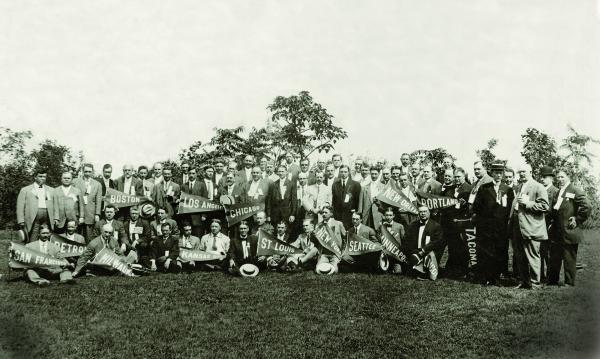
Rotary’s first fiscal year began the day after the first convention ended, on 18 August 1910. The 1911-12 fiscal year also related to the convention, beginning with the first day of the 1911 convention on 21 August.
At its August 1912 meeting, the Board of Directors ordered an audit of the International Association of Rotary Clubs’ finances. The auditors recommended that the organization end its fiscal year on 30 June to give the secretary and treasurer time to prepare a financial statement for the convention and board, and determine the proper number of club delegates to the convention.
The executive committee concurred, and at its April 1913 meeting, designated 30 June as the end of the fiscal year. This also allowed for changes to the schedule for reporting club membership and payments. Even The Rotarian changed its volume numbering system to correspond to the fiscal year (beginning with vol. 5, July 1914).
Rotary continued to hold its annual conventions in July or August until 1917. Delegates to the 1916 event in Cincinnati, Ohio, USA, approved a resolution to hold future conventions in June, mainly because of the heat in cities where most of them occurred. The next one was held 17-21 June in Atlanta, Georgia.
The term “Rotary year” has been used to signify Rotary’s annual administrative period since at least 1913. An article in The Rotarian that July noted, “The Rotary year that is rapidly drawing to a close has been signalized by several highly successful joint meetings of Clubs that are so situated as to assemble together easily and conveniently.”
Since the executive committee’s decision in 1913, the end of the Rotary year has remained 30 June.
 Rotary Club of San Benito, Texas